

- Published on
AI Trading Software: Key Features, Costs, and Limitations
Listen to the full article:
- Authors

- Name
- Jagadish V Gaikwad
AI Trading Software Is Not a Cheat Code
Stop pretending AI trading software is some money printer with a fancy dashboard. It’s a decision system, not a guarantee, and the difference matters when real cash is on the line.
The best platforms use machine learning, real-time scanning, automated execution, and predictive analytics to help traders move faster and make cleaner decisions. But the moment you treat it like a robot genius instead of a flawed tool, you’re already setting yourself up to get wrecked.
What AI Trading Software Actually Does
Look, here’s the real job: it processes more market data than you ever could. Price history, order flow, news sentiment, macro signals, technical patterns, and sometimes alternative data all get shoved into models that spit out signals, alerts, or trade ideas.
Interactive Brokers says these systems are built to support analysis, automate trades when conditions hit, and forecast likely market moves. That’s the core promise, and it’s useful as hell if you know what to do with it.
Key Features That Actually Matter
Honestly? Most marketing pages scream about “AI” like that word alone pays bills. Ignore the hype and look for the stuff that changes how you trade.
- Real-time market scanning: The software should watch the market while you sleep, work, or doomscroll, and flag setups as they happen.
- AI-generated trade signals: Tools like Trade Ideas are known for signal generation, while TrendSpider is stronger on automated technical analysis.
- Automated execution: Some platforms can place trades when your rules trigger, which saves time but also creates new ways to screw up fast.
- Predictive analytics: Good systems try to forecast trends using machine learning, not just basic rule matching.
- Risk controls: Built-in stop-loss logic, position sizing, and exposure checks matter more than flashy charts.
- Backtesting: If you can’t test the strategy on historical data, you’re guessing with extra steps.
- Transparency: You need to see why the software fired a signal, or you’ll end up trusting a black box you don’t understand.
Why Adaptive Models Beat Static Rules
Here’s the thing: markets change. Fast. Static rule sets break the second volatility shifts, liquidity dries up, or the news cycle gets weird.
That’s why adaptive models matter so much. TradeAlgo says true AI trading software uses machine learning models that retrain on new data, and Lycore notes that regularly retrained models adapt to regime changes better than fixed rules. If the model never updates, you’re basically running yesterday’s playbook in today’s market.
This is where a lot of traders get lazy. They buy a tool, run one setup, and act shocked when it stops working three months later.
What It Costs in 2026
Real talk: pricing is all over the place. Some tools are cheap enough for hobby traders, and others cost more than your rent.
| Platform | Typical Cost | Best For | Real Talk |
|---|---|---|---|
| Trade Ideas | Paid subscription, premium-tier pricing | AI signals and active stock traders | Great if you want fast ideas, not if you want a passive set-and-forget box |
| TrendSpider | Paid subscription, multiple tiers | Technical traders and chart-heavy workflows | Strong for automation and scanning, but you still need to know what you’re doing |
| Danelfin | Free tier plus paid plans | Beginners testing AI scoring | The free tier is attractive, but free tools rarely give you the full picture |
| TradeAlgo | Premium/institutional pricing | Dark pool and options flow traders | Powerful, but this is not cheap beginner bait |
| General AI trading platforms | About $59 to $199 per month in many cases | Retail traders and small teams | Good middle ground if you want serious tools without institutional pricing |
That pricing range is a clue. If a platform costs almost nothing, it’s usually giving you basic signals, thin data, or limited controls. If it’s expensive, you’re paying for better data, better scanning, and fewer toys you don’t need.
The Hidden Costs Nobody Advertises
The annoying part is that the subscription fee is the easy number. The real costs show up later, and they’re messier.
You’ll pay in time, testing, and bad trades before you ever see anything useful. For real-world use, one guide recommends paper trading first, then small positions, then close monitoring of signal quality, fills, and latency.
There’s also the cost of cleaning up bad assumptions. If your strategy ignores slippage, transaction fees, or liquidity, your backtest can look amazing and your live account can look stupid.
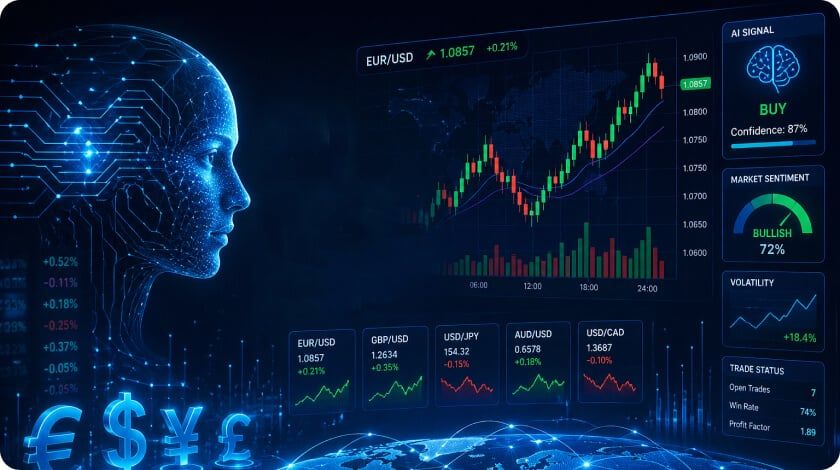
Where AI Trading Software Breaks
Yeah, this is the part vendors don’t love talking about. AI trading software can fail hard, and usually for boring reasons.
Overfitting is a classic mess. A strategy can look brilliant in backtests and then fall apart live because it learned noise instead of signal. That’s why walk-forward validation and out-of-sample testing matter so much.
Then there’s data quality. Garbage in, garbage out still applies, even when the interface has slick gradients and a chatbot.
LLM-driven tools add another problem: hallucinations. QuantInsti points out that AI systems can generate confident but wrong logic or code, which is terrifying when that logic controls trades. One bad assumption can snowball across hundreds of orders in minutes.
AI Trading Software vs Traditional Trading Tools
If you’re still deciding whether this is worth it, compare the actual experience, not the sales pitch.
| Aspect | AI Trading Software | Traditional Trading Tools |
|---|---|---|
| Speed | Scans huge data sets in seconds | Slower, more manual |
| Signals | Pattern-driven and predictive | Usually rule-based or human-led |
| Automation | Can place trades automatically | Often requires manual execution |
| Learning Curve | Higher, because you need to judge model quality | Lower, because the logic is simpler |
| Risk | Can fail in weird, non-obvious ways | Easier to understand, but less adaptive |
| Real Talk | Worth it if you test hard and stay hands-on | Better if you want control and simplicity |
If you want speed plus adaptive analysis, AI wins. If you want full transparency and fewer surprises, traditional tools are still solid.
What Smart Traders Do Before Going Live
Here’s what nobody talks about enough: the best traders don’t trust the first clean backtest. They try to break the thing before it breaks them.
Forextester recommends starting with one market, one timeframe, clear entry and exit rules, and at least 100 backtested trades before taking anything seriously. That’s not sexy, but it’s how you avoid becoming another guy who bought a bot and donated money to the market.
A sane workflow looks like this:
- Start with paper trading.
- Run the strategy on a small universe.
- Check win rate, drawdown, and slippage.
- Compare signal quality against actual fills.
- Keep manual oversight on every live run.
That last one matters. You should never hand over blind control and hope the machine “gets it.”
Who AI Trading Software Is Actually For
Look, not everyone needs this. If you trade once a month and hate charting, you probably don’t need a premium AI stack.
This stuff makes the most sense for active traders, small funds, and serious retail users who want faster screening, better pattern detection, and semi-automated execution. It’s also useful if you’re already comfortable with backtesting and risk management, because that’s where the edge shows up.
If you’re brand new, AI trading software can make you overconfident fast. The interface feels smart. The results look scientific. Your first live loss will humble you immediately.
What to Watch Before You Buy
Here’s the practical checklist. If a platform can’t do these things, keep moving.
- Adaptive models that retrain on new data
- Transparent signals you can actually inspect
- Backtesting with enough history to mean something
- Risk controls like stops and sizing rules
- Paper trading before you put real money in
- Data clarity so you know where the signals come from
- Market coverage that matches what you actually trade
If the platform hides its logic, that’s not sophistication. That’s a problem wearing a blazer.
The Bottom Line on Costs and Limits
AI trading software is worth the money when it saves you time, catches patterns you’d miss, and helps you manage risk better than your gut ever could. It’s a waste when you buy it for the vibe and never test whether it actually improves results.
The biggest limitation is simple: markets aren’t stable, and models are only as good as the data and assumptions behind them. That means the software can help you trade smarter, but it can’t remove uncertainty, and it definitely can’t save you from sloppy thinking.
Real talk: this only works if you stay involved. Most people want automation without discipline, and that combo usually ends badly.
What’s your bigger problem right now: finding a tool you trust, or figuring out whether your trading process is even good enough for AI?
You may also like
- Why Argentina is the Greatest Football Team Ever: The Messi Era and Historic Dominance
- AI Agents vs Traditional Automation Explained: The Ultimate Guide for 2026
- Qualcomm Dragonwing Q-6690 RFID CPU: The Future of Enterprise Mobile Processing
- How Generative AI is Disrupting SaaS Product Design in 2025
- Best AI Writing Tools for Bloggers and YouTubers in 2025: Ultimate Guide to Boost Your Content Creation