

- Published on
AI-Powered Smart Order Routing for Crypto: How It Works and What to Check
Listen to the full article:
- Authors

- Name
- Jagadish V Gaikwad

What is AI-powered smart order routing for crypto?
AI-powered smart order routing for crypto is a trading system that decides where and how to execute a cryptocurrency order across exchanges, decentralized exchanges, liquidity pools, and sometimes multiple blockchain networks.
Instead of sending a swap to one venue, the router compares available opportunities and may:
- Choose one exchange or liquidity pool
- Split the order across several venues
- Use a multi-hop route through an intermediate token
- Delay execution briefly when market conditions justify waiting
- Select a private transaction path to reduce exposure to certain forms of maximal extractable value, or MEV
Traditional smart order routing already uses rules, live quotes, fee schedules, liquidity data, and slippage limits. The “AI-powered” label usually refers to machine-learning models added to parts of that process, such as short-term liquidity prediction, execution-cost estimation, anomaly detection, or route scoring.
The key point is that AI does not remove trading risk. It changes how a routing system estimates and responds to changing conditions. A useful router should optimize the complete execution outcome rather than simply select the venue displaying the highest headline price.
Why crypto needs smart order routing
Crypto liquidity is fragmented. A single asset pair may trade across centralized exchanges, automated market makers, aggregators, order books, and pools on several chains. Each venue can have different prices, fees, depth, latency, settlement behavior, and failure risks.
A DEX aggregator such as 0x Swap API describes smart routing that sources prices from many liquidity providers and can split a transaction across multiple sources. DexGuru’s meta-aggregation documentation describes a related approach: comparing quotes from multiple exchange aggregators rather than relying on only one routing service.
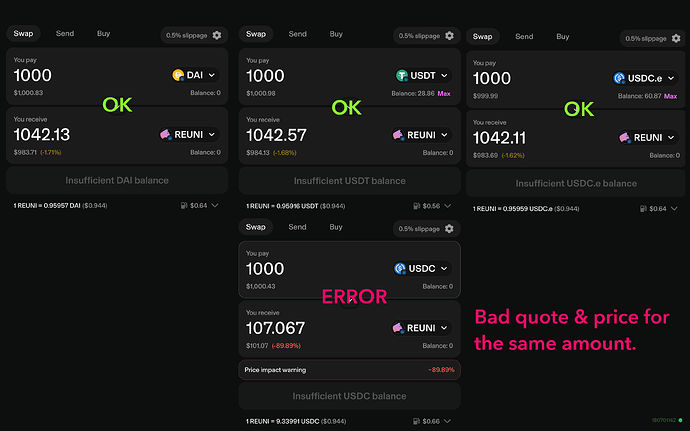
A visible price is not the same as an executable price. A quote can deteriorate because:
- The order is large relative to available pool liquidity
- Other transactions change the pool before settlement
- Network fees exceed the expected routing advantage
- A route uses several pools and accumulates fees
- A token has transfer restrictions or unusual contract behavior
- The exchange or bridge becomes unavailable
- The order is delayed during a volatile market
For that reason, the relevant objective is normally total execution cost. In plain language, estimated net execution equals the received asset value minus trading fees, network fees, price impact, expected slippage, and other route-specific costs.
How the routing process works
An AI-assisted router typically combines deterministic transaction logic with statistical predictions. The exact design differs by provider, but the workflow usually follows these stages.
1. Collect market and network data
The system gathers current information from available venues, including:
- Bid and ask prices on order-book exchanges
- Reserves and fee tiers in automated market-maker pools
- Available trade size at each price level
- Gas prices and estimated transaction costs
- Block times and recent transaction-confirmation behavior
- Token metadata and contract warnings
- Historical route performance
- Current failure, revert, and latency rates
Data quality is a major limitation. On-chain data can be transparent without being clean. A pool may show large reserves but offer poor execution because of its fee tier, token mechanics, or a competing transaction that has not yet settled.
2. Generate candidate routes
The router creates possible execution paths. A direct swap may be best for a small order, while a larger order could be distributed across several pools. A route might also use an intermediate asset if the direct pair has insufficient liquidity.
For example, a system converting Token A to Token C could compare:
- A directly to C in one pool
- A to B, then B to C
- A split between two direct pools
- A multi-hop route combined with a second venue
The number of routes can grow quickly, so practical systems use search limits and pruning rules. A theoretically attractive route may be rejected if it requires too many calls, consumes excessive gas, or depends on unreliable liquidity.
3. Estimate execution quality
The router evaluates each candidate using more than the displayed exchange rate. Important inputs include:
- Expected output after venue fees
- Network and execution costs
- Price impact
- Slippage tolerance
- Probability of transaction failure
- Expected latency
- Liquidity concentration
- Counterparty or smart-contract risk
- MEV exposure
- Bridge or settlement risk for cross-chain trades
Machine-learning models can estimate variables that are difficult to express with fixed rules. A model might predict how much liquidity will remain available during the next few blocks or estimate the probability that a route will fail under current congestion.
Those predictions remain estimates. A model trained on calm conditions can behave poorly during a liquidation cascade, chain outage, oracle disruption, or sudden liquidity withdrawal.
4. Select and execute the route
After scoring the candidates, the system selects a route subject to hard constraints. Typical constraints include a minimum acceptable output, maximum slippage, approved tokens, gas limits, and an expiration time.
The router may also use a private transaction relay or another protected submission method. This can reduce exposure to public-mempool observation, but it does not eliminate all execution risks. A private path can have its own availability, trust, and delivery assumptions.
5. Measure the result
A serious routing system should compare its estimate with the actual result. Useful measurements include:
- Quoted output versus settled output
- Expected cost versus realized cost
- Successful versus reverted transactions
- Route latency
- Slippage distribution
- Gas estimation error
- Results by venue, chain, token, and order size
Without this feedback loop, “AI-powered” may simply mean that a model is present somewhere in the stack. It does not demonstrate that the model improves execution.
What AI can improve
AI is most useful when it handles prediction or classification around a rule-based execution core.
Short-horizon liquidity forecasting
A model can estimate whether a pool is likely to remain usable over a short period. It may consider recent swaps, liquidity changes, block activity, and volatility. This can help the router avoid routes that look attractive in a single snapshot but are unstable.
Execution-cost prediction
The best route at the quoted price may not be the best route after settlement. A predictive model can estimate likely slippage, gas usage, confirmation delay, and failure probability before ranking the route.
Dynamic order splitting
Splitting an order can reduce price impact, but too many fragments can increase gas costs and operational complexity. AI can help estimate the trade-off between concentration and diversification for a particular order size and market state.
Anomaly detection
Models can flag unusual pool behavior, sudden reserve changes, suspicious token transfers, abnormal price movements, or a sharp increase in failed transactions. These alerts should normally trigger additional checks rather than automatically prove that a token or venue is malicious.
Timing and venue selection
Some systems may estimate whether immediate execution or a brief delay offers a better expected outcome. This is a forecasting problem, not a guarantee. Waiting can improve a quote, but it can also expose the order to a larger adverse price movement.

AI routing does not solve MEV
MEV is value captured by participants who can influence transaction ordering, inclusion, or execution around blockchain transactions. Common user-facing concerns include front-running, back-running, and sandwich attacks.
The SEC Crypto Task Force written input identifies MEV and slippage among structural risks associated with automated market makers. Recent research on MEV extraction in fast-finality blockchains also illustrates that transaction-ordering environments can influence arbitrage strategies.
A better router can reduce some exposure by:
- Setting strict minimum-output and expiration parameters
- Avoiding unnecessarily large public-mempool transactions
- Selecting pools with sufficient depth
- Splitting orders when the cost-benefit calculation supports it
- Using private submission channels where appropriate
- Rejecting routes with suspicious price or liquidity changes
However, private execution is not automatically safer in every respect. Users still need to understand who operates the relay, what information it receives, whether transactions can be delayed, and what happens if the protected path fails.
MEV protection should therefore be treated as one input in route evaluation, not as a universal safety claim.
Smart order routing approaches compared
| Approach | How it chooses a route | Main strength | Main limitation |
|---|---|---|---|
| Single-venue execution | Sends the order to one selected exchange or pool | Simple and often fast for liquid pairs | Can miss better liquidity elsewhere |
| Rule-based aggregation | Compares quotes and applies fixed routing rules | Easier to inspect and test | Less adaptive to changing conditions |
| AI-assisted routing | Uses models to predict costs, liquidity, failures, or timing | Can adapt route scoring to market conditions | Model errors can create systematic losses |
| Meta-aggregation | Compares quotes from multiple aggregators | Broadens the search across routing systems | Adds complexity, latency, and approval considerations |
| Cross-chain routing | Considers venues and settlement across networks | Can access more liquidity | Adds bridge, finality, and counterparty risks |
The comparison is not a claim that one approach always wins. A transparent rule-based router may be preferable for a small trade when the available liquidity is already deep. AI-assisted routing becomes more defensible when prediction materially improves a measurable execution problem and the system has strong fallback rules.
Risks specific to AI-powered routing
Training-data and regime risk
Historical data may not represent future conditions. A model trained on ordinary volatility can fail during a market-wide liquidation event. A model trained on one chain may not transfer safely to another chain with different block production, liquidity behavior, and transaction costs.
False precision
A probability estimate can look scientific while remaining uncertain. If a model predicts a low failure probability, the result may still be wrong because the input data is delayed, incomplete, manipulated, or outside the training distribution.
Feedback loops
If many routers learn from similar data and choose similar pools, their decisions can reinforce concentration. A liquidity venue that receives more flow may appear even more attractive, while less-used venues lose activity. This can increase dependence on a smaller number of infrastructure providers.
Adversarial behavior
Market participants may attempt to influence the data used by a routing model. They could create artificial volume, move liquidity temporarily, submit transactions that distort observed conditions, or exploit predictable route-selection behavior.
Operational and smart-contract risk
A high-quality model cannot compensate for a vulnerable contract, incorrect token approval, faulty gas estimation, broken API, or compromised signing system. The SEC report on algorithmic trading emphasizes that technology development, testing, and implementation errors can have severe effects.
Conflicts of interest
A router may receive rebates, referral payments, order-flow payments, or other economic benefits from a venue. The SIFMA written input to the SEC Crypto Task Force discusses concerns that proprietary routing logic could favor affiliated or economically biased interests.
A “best route” label should therefore be accompanied by clear information about fees, incentives, supported venues, and whether the ranking is based on gross price or expected net execution.
How to evaluate a crypto AI routing product
Before relying on a router, ask for evidence rather than marketing language.
Check the objective
Does the system optimize received output after fees and gas, or does it optimize a simpler metric such as displayed price? The objective should be understandable and aligned with the user’s trade.
Inspect the controls
Look for:
- Minimum received amount
- Maximum slippage
- Transaction deadline
- Maximum gas or fee limits
- Approved venue and token lists
- Route simulation
- Revert handling
- Emergency pause or fallback behavior
These controls matter even when the AI component is disabled.
Review performance reporting
Useful reporting separates quoted and realized results. It should show execution quality by asset, order size, chain, and market condition rather than publishing only an attractive average.
Understand data and incentives
Find out which venues are included, how often quotes are refreshed, whether the provider earns venue-specific compensation, and whether the model can route to affiliated services.
Test conservatively
A reasonable evaluation begins with small transactions and liquid pairs. Compare the router with a transparent baseline, record the quote and settlement details, and examine the complete cost. A successful small test does not prove that the system will handle a large or volatile order safely.
Verify security claims
Look for public documentation, contract addresses, audit scope, incident disclosures, permission details, and independent monitoring. An audit is evidence about a defined review, not a guarantee against every operational or economic failure.
A practical decision framework
For each proposed trade, evaluate five questions:
Is the route executable?
Does the quoted liquidity appear deep enough for the order, and can the transaction settle within the quote’s validity period?What is the all-in cost?
Include trading fees, gas, price impact, expected slippage, bridge costs, and the possibility of failure.What can go wrong?
Consider contract risk, token restrictions, MEV, oracle dependence, chain congestion, and venue outages.Does AI add measurable value?
Ask whether the model improves route selection or merely makes the product harder to inspect.What is the fallback?
A router should have a defined response when data is stale, a quote disappears, a model is uncertain, or a transaction fails.
This framework is useful for both individuals and teams building crypto trading infrastructure. It also clarifies where automation should stop. A system can automatically rank routes while requiring explicit user approval for unusual tokens, cross-chain settlement, or unusually high slippage.
Conclusion
AI-powered smart order routing for crypto is best understood as predictive execution infrastructure, not autonomous financial intelligence. Its value comes from combining fragmented liquidity data with cost estimation, route search, execution controls, and continuous measurement.
The strongest designs use AI where prediction helps, but keep hard safety constraints outside the model. They account for total execution cost, disclose incentives, measure realized outcomes, and provide clear fallbacks when market conditions become unusual.
For users, the practical test is simple: compare the router’s promised benefit with its complete execution record and risk controls. For builders, the priority is not adding an AI label. It is proving that the system consistently improves execution without hiding fees, concentrating risk, or weakening user control.

You may also like
- AI and Ethereum Whale Tracking: A Practical Guide to On-Chain Intelligence
- AI Trading Risk Management: Strategies Every Trader Should Know
- How Messi Can Lift the FIFA World Cup Once Again: Argentina’s 2026 Title Defense
- AI in Investment Banking: Use Cases and Examples That Actually Matter
- Best AI Tools for Crypto Research and Portfolio Analysis in 2026