

- Published on
How AI Optimizes Crypto Trade Execution
Listen to the full article:
- Authors

- Name
- Jagadish V Gaikwad

Crypto trade execution is the process of turning a trading decision into completed orders. The decision might be to buy Bitcoin, sell an altcoin, rebalance a portfolio, or swap tokens through a decentralized exchange. Execution determines how much the trade actually costs, how quickly it fills, and how much price movement occurs while the order is being completed.
How AI optimizes crypto trade execution is best understood as a market-microstructure problem, not a promise that an algorithm can predict prices perfectly. AI can analyze order books, estimate liquidity, divide a large order into smaller pieces, compare venues, and adapt to partial fills. It can also introduce new risks through faulty data, excessive trading, model drift, API failures, and adversarial transaction ordering.
The strongest systems use AI to improve decisions around how to trade while keeping limits, approvals, and emergency controls explicit.
What trade execution means in crypto
A market order prioritizes immediate execution but accepts the available prices. A limit order specifies a maximum purchase price or minimum sale price, but it may not fill. A larger order can use a combination of both approaches, depending on urgency and available liquidity.
Execution quality usually involves several competing objectives:
- Minimize the difference between the expected price and the average filled price.
- Reduce market impact, which is the price movement caused by the order itself.
- Complete the trade within a required time window.
- Avoid unnecessary fees, failed transactions, and unfavorable routing.
- Limit exposure to volatility while the order remains incomplete.
These objectives conflict. A trader who demands an immediate fill may consume several levels of the order book and move the price. A trader who waits for a better price may reduce the visible cost but face greater exposure to an adverse market move.
Traditional optimal-execution research formalizes this trade-off between price risk and market impact. Recent analysis of AI in financial markets describes sequential learning as a natural fit for execution because an agent can adjust order placement as the order book and fill state change.(https://arxiv.org/html/2609.04917v1)
Crypto adds extra complexity because liquidity is fragmented across centralized exchanges, decentralized exchanges, aggregators, and blockchain networks. Each venue can have different fees, latency, settlement conditions, token availability, and counterparty or smart-contract risks.
Where AI enters the execution process
AI does not need to control every trading decision to be useful. It can support individual stages of the workflow.
1. Reading market conditions
An execution system can combine order-book data, recent trades, spreads, trading volume, volatility, funding rates, and network conditions. Machine-learning models may then classify the current environment as highly liquid, thin, fast-moving, or unusually unstable.
This classification helps determine whether an order should be executed aggressively or patiently. For example, a system may use smaller slices when the spread is wide and displayed liquidity is thin. It may use more immediate execution when a strict deadline matters more than minimizing market impact.
The output should be treated as an estimate, not a fact. Order books can change in milliseconds, and visible liquidity may disappear before an order reaches the venue.
2. Estimating market impact
A large order can consume the best available bids or offers and push the execution price away from the initial quote. AI models can estimate this effect by learning from historical order-book states, trade sizes, volatility, and previous fills.
A useful estimate separates several costs:
- The spread paid to cross from one side of the market to the other.
- Market impact caused by consuming available liquidity.
- Exchange, broker, or network fees.
- Slippage caused by price movement between decision and settlement.
- Failed or reverted transaction costs where applicable.
A model that predicts only the quoted price is incomplete. The relevant question is the expected all-in execution cost under the specific size, venue, and time constraint.
3. Splitting orders into smaller pieces
Instead of submitting one large order, an algorithm can divide it into smaller child orders. This may reduce the immediate footprint and give the market time to replenish.
Common execution patterns include:
- Time-based slicing: Submit portions at scheduled intervals.
- Volume-based execution: Trade in proportion to observed market volume.
- Liquidity-aware execution: Increase or reduce order size according to available depth.
- Participation strategies: Target a specified share of market activity.
- Adaptive execution: Change timing, size, and order type when conditions shift.
AI can select among these behaviors or adjust their parameters. Reinforcement-learning research is especially relevant because the system can treat each order placement as an action and each fill, cost, or risk event as feedback. However, training performance does not automatically transfer to live markets. A model can perform well in historical simulations while failing when liquidity, fees, competitors, or market behavior change.
4. Choosing among venues
Smart order routing compares potential execution paths rather than sending every order to one preferred venue. In centralized markets, the route may involve multiple exchanges or broker connections. In decentralized finance, an aggregator may compare liquidity pools and split a swap across routes.
For example, the 0x Swap API describes a decentralized-exchange aggregation and smart-routing service intended to find favorable prices for token trades. A centralized exchange can also expose REST and WebSocket interfaces for market data and order activity, as documented by the Crypto.com Exchange API.
The best displayed price is not necessarily the best route. A practical router should also evaluate:
- Trading and gas fees.
- Available depth for the requested size.
- Expected slippage.
- Latency and quote expiry.
- Settlement and confirmation time.
- Smart-contract and bridge exposure.
- Exchange reliability and withdrawal constraints.
- The risk of partial completion.
AI can rank these alternatives, but the routing policy should specify unacceptable venues and minimum liquidity thresholds before the model makes a recommendation.
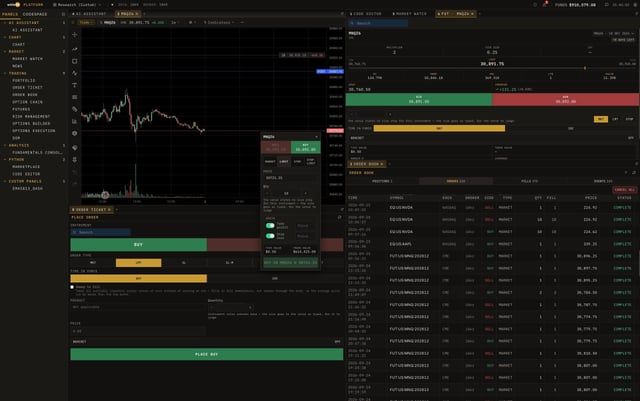
How AI handles centralized and decentralized execution
The core objective is similar across markets, but the mechanics differ.
| Execution environment | What AI can optimize | Main additional risk | Practical control |
|---|---|---|---|
| Centralized exchange | Venue selection, order slicing, limit prices, and fill timing | API outage, counterparty exposure, stale data, or rejected orders | Venue limits, authenticated connections, and cancel-on-error rules |
| Decentralized exchange | Pool selection, route splitting, gas timing, and slippage tolerance | Smart-contract failure, sandwiching, failed swaps, and network congestion | Transaction simulation, strict slippage limits, and approved contracts |
| Cross-venue execution | Price differences, inventory allocation, and transfer timing | Transfer delays, settlement mismatch, and balance shortages | Pre-funded balances and explicit settlement checks |
| Derivatives venue | Order type, leverage exposure, and liquidation risk | Funding changes, mark-price effects, and forced liquidation | Position caps, margin buffers, and automated shutdown rules |
On a centralized exchange, the model usually sends orders through an API. WebSocket feeds can provide lower-latency updates about prices, order-book changes, and fills, while REST endpoints may handle account actions or order management.
On a decentralized exchange, the system must construct a blockchain transaction. It may need to estimate gas, select a route, set a deadline, choose slippage protection, and confirm that the transaction succeeded. The model therefore interacts with both market conditions and a settlement system.
AI and maximal extractable value
Decentralized execution also creates exposure to maximal extractable value, commonly called MEV. Ethereum describes MEV as value obtained by controlling the inclusion, exclusion, or ordering of transactions beyond the standard block reward and gas fees.(https://ethereum.org/developers/docs/mev)
A visible swap can reveal useful information before it is confirmed. Other participants may attempt to place transactions around it, change execution conditions, or capture an arbitrage opportunity. A user can therefore receive a worse price even when the original route appeared attractive.
AI can help detect conditions associated with higher execution risk. It may compare public and private transaction routes, estimate the likelihood of adverse ordering, or reject trades when expected costs exceed a threshold. It cannot guarantee protection from MEV, especially when the system depends on public transaction propagation or incomplete network information.
The same technology can also be used offensively. Research on fast-finality blockchains has examined how arbitrageurs split transactions into smaller pieces to reduce failure risk and maximize expected profit under particular network and ordering conditions.(https://arxiv.org/html/2506.01462v1) This illustrates why execution models operate in an adversarial environment: other participants may adapt after observing the strategy.
A practical AI-assisted execution workflow
A reliable workflow separates prediction from permission. The model can recommend an action, but deterministic rules should decide whether that action is allowed.
Step 1: Define the order
Record the asset, side, quantity, deadline, acceptable price range, preferred venues, and maximum total cost. Specify whether completion is mandatory or whether an unfilled remainder can be canceled.
Step 2: Validate data
Check timestamps, missing fields, symbol mappings, balances, and order-book sequence numbers. Reject stale or inconsistent data instead of allowing the model to infer through a bad feed.
Step 3: Build an execution estimate
Estimate spread, fees, market impact, expected slippage, and failure costs. For a decentralized trade, include gas, route risk, and the possibility of a reverted transaction.
Step 4: Select a strategy
Choose among immediate execution, passive limit orders, time slicing, volume participation, or route splitting. The choice should reflect urgency and liquidity rather than a generic preference for automation.
Step 5: Recalculate after each fill
Update the remaining quantity, average price, current market state, and risk limits. A strategy that was sensible for the first portion of an order may be inappropriate after volatility increases.
Step 6: Apply hard controls
Use maximum order size, venue allowlists, price collars, position limits, cancellation rules, and a kill switch. Do not allow a model to override these controls because a confidence score is high.
Step 7: Review the result
Compare the realized execution with the pre-trade estimate. Track fill rate, average price, spread cost, market impact, fees, latency, rejection rate, and missed opportunities. A model should be improved using this evidence rather than judged only by headline profitability.
What AI cannot reliably solve
AI is not a substitute for liquidity. If a market has little genuine depth, a sophisticated model cannot create buyers or sellers without taking more price risk.
It also cannot eliminate uncertainty. Historical data may omit exchange outages, delistings, token contract changes, extreme volatility, or new forms of market manipulation. Backtests can be distorted by survivorship bias, unrealistic fills, look-ahead bias, and fees that were not available at the time.
Crypto systems face operational risks that are separate from model quality:
- API credentials may be exposed or misconfigured.
- Exchange rate limits may delay or reject orders.
- A WebSocket connection may disconnect during a fast market.
- A blockchain transaction may remain pending or fail.
- A token contract may impose transfer restrictions or unexpected fees.
- A venue may freeze withdrawals or become unavailable.
- A model may repeat an error across many accounts before detection.
Security therefore belongs inside execution design. API keys should use the narrowest permissions needed, withdrawal permissions should be restricted where possible, and order activity should be monitored for unusual size, frequency, venue, or asset changes.
How to evaluate an AI execution system
A credible evaluation uses more than profitable backtest results. Start with a realistic simulator that accounts for historical spreads, order-book depth, fees, latency, partial fills, and rejected orders. Then test the model across calm, volatile, illiquid, and rapidly changing conditions.
Useful measurements include:
- Implementation shortfall against a defined arrival price.
- Cost per completed unit after fees and network expenses.
- Fill rate within the required time window.
- Market impact relative to comparable orders.
- Cancellation and rejection rates.
- Exposure to adverse price movement while waiting.
- Performance degradation when data is delayed or incomplete.
- Results after removing the best-performing periods.
Run a paper-trading phase before using meaningful capital. Live paper results still cannot reproduce every settlement or counterparty risk, but they can reveal broken assumptions about latency, symbols, permissions, and order behavior.
A good evaluation also includes a failure test. Disconnect a data feed, return malformed market data, make an order partially fill, exceed a rate limit, and simulate a rapidly widening spread. The expected response should be cancellation, throttling, or escalation—not uncontrolled trading.
A decision framework for using AI
AI is most defensible when the task is repetitive, data-rich, and measurable. It is less defensible when liquidity is too thin to model, the asset has unusual contract behavior, or the cost of an error is unacceptable.
Use an AI-assisted system when:
- Execution involves repeated orders across several venues.
- Market data is available with reliable timestamps.
- The objective can be expressed through measurable cost and risk limits.
- Human or automated oversight can review exceptions.
- The system can operate with restricted permissions.
Use a simpler rule-based system when:
- Order sizes are small relative to reliable market depth.
- The strategy needs only basic limit-price protection.
- Data quality is poor or latency is unpredictable.
- The operational risk of automation exceeds the expected execution benefit.
The choice is not between “AI” and “no AI.” A layered system may use fixed safety rules, statistical cost estimates, and AI only for venue ranking or timing. This arrangement makes errors easier to detect and limits the damage from a model that behaves unexpectedly.

Conclusion
AI optimizes crypto trade execution by improving the sequence of choices between an intended trade and its final settlement. It can interpret changing liquidity, estimate market impact, split orders, compare venues, adapt to partial fills, and identify conditions where execution costs are likely to rise.
Its value depends on implementation. A model trained on clean historical data can still fail because live liquidity disappears, APIs disconnect, fees change, transactions encounter network congestion, or other participants exploit predictable behavior. For decentralized trades, MEV and smart-contract risk add another layer that price prediction alone cannot address.
The most practical design combines adaptive models with explicit cost estimates, venue controls, transaction simulation, conservative limits, continuous monitoring, and a tested emergency shutdown. AI should make execution more informed and disciplined—not remove human responsibility for where, when, and under what risks capital is deployed.
You may also like
- Google Ordered to Pay $425 Million in Damages for Privacy Violations: What You Need to Know
- Top AI-Powered Project Management Tools Compared: Efficiency Redefined
- How to Backtest an AI Trading Strategy Before Risking Money
- The Top Five PC Hardware Launches To Watch Out For In 2025
- The Future of AI in Finance: Trends to Watch in 2026