

- Published on
How AI Turns Blockchain Data Into Investment Insights
Listen to the full article:
- Authors

- Name
- Jagadish V Gaikwad
Blockchain networks produce a continuous record of transactions, token movements, smart-contract interactions, liquidity changes, and wallet activity. AI turns this raw blockchain data into investment insights by cleaning it, finding patterns, ranking signals, and translating on-chain behavior into questions investors can investigate.
That process can improve research speed, but it does not create certainty. Blockchain data is incomplete, wallet identities are often unknown, and models can mistake noisy activity for meaningful demand. The most reliable approach treats AI as a research assistant rather than an autonomous investment decision-maker.
What blockchain data can reveal
Blockchain data, often called on-chain data, records activity directly on a public network. Depending on the chain and the tools used, researchers may examine:
- Transaction counts and active addresses
- Token transfers between wallets
- Exchange deposits and withdrawals
- Liquidity supplied to decentralized exchanges
- Lending deposits, borrowing, and liquidations
- Smart-contract calls
- Validator or staking activity
- Treasury transactions
- Bridge flows between networks
- Fees paid by users
- Changes in token-holder concentration
The raw information is not automatically an investment insight. A large transfer may represent a trade, an internal treasury movement, collateral management, or a custody change. The analytical challenge is connecting an observable transaction to a plausible economic explanation without overstating what the data proves.
Platforms such as Dune’s analytics documentation describe on-chain analysis as a way to track protocol performance, market trends, ecosystem activity, and investment research. Dune also separates raw, decoded, and curated datasets, which helps analysts move from low-level blockchain records toward more usable research tables.Dune’s data catalog describes coverage across more than 100 blockchains as of October 2026.
How AI transforms blockchain data
AI does not replace the blockchain ledger. It works on top of the ledger and related market data. A typical workflow has five stages.
1. Data collection and normalization
The first step is gathering data from block explorers, node providers, analytics platforms, decentralized-exchange records, token contracts, and market feeds.
Different chains often describe similar events in different ways. One network may expose a token transfer through a standard event, while another requires a different query structure. Even within one chain, raw records may need to be decoded into recognizable actions such as swaps, deposits, withdrawals, or liquidations.
AI can help classify and normalize these records, but the underlying data design still matters. Dune describes a layered approach that includes raw data, decoded data, and curated tables. Curated tables can make cross-chain analysis easier, while raw tables remain useful for checking whether a conclusion is grounded in the original record.
A useful rule is simple: the more important the investment conclusion, the closer the analyst should return to the source data.
2. Entity and wallet classification
Blockchains usually identify addresses, not people or companies. AI can group addresses according to observable behavior, labels from data providers, contract interactions, and transaction history.
This can help distinguish possible categories such as:
- Exchange-controlled wallets
- Protocol treasury addresses
- Liquidity-provider wallets
- Large individual holders
- Automated trading contracts
- Bridge contracts
- Governance-related addresses
Classification is probabilistic. A wallet that receives funds from an exchange may not belong to a single investor. A cluster of addresses may be controlled by one entity, or it may reflect unrelated users interacting with the same service.
For that reason, a model should describe an address as “likely associated with” a category unless ownership is independently verified. Treating wallet labels as facts can produce false signals about accumulation, selling, or insider activity.
3. Pattern detection
AI can scan large datasets for changes that would be difficult to monitor manually. These changes may include:
- A rapid increase in new wallet activity
- Falling liquidity alongside rising trading volume
- Growing borrowing against a token
- Concentration of supply among a small number of addresses
- Unusual transfers before a major announcement
- Repeated interactions with a newly deployed contract
- Large withdrawals from a lending protocol
- Changes in fee generation or user retention
The model may use statistical methods, anomaly detection, clustering, or language models connected to data-query tools. Dune documents AI-powered tools that can generate, edit, and debug SQL queries in its query editor.Dune’s AI query documentation This can lower the technical barrier for asking questions of blockchain datasets, but generated queries still require human review.
An anomaly is not automatically a signal to buy or sell. It is a reason to investigate what changed and why.
4. Feature creation and scoring
AI systems convert observations into features, meaning measurable inputs used for comparison or modeling. Examples include:
- Seven-day change in active addresses
- Share of token supply held by the largest wallets
- Net exchange inflows over a selected period
- Protocol fees relative to token incentives
- Borrowing growth compared with available liquidity
- Percentage of volume generated by repeat users
- Number of wallets that remain active after an initial interaction
A model may then rank assets, protocols, or events according to a chosen objective. For example, a researcher could create a screening process that prioritizes protocols with increasing fee revenue, stable liquidity, and broadening user activity.
The score is only as meaningful as its inputs. A model trained on transaction volume may favor wash trading. A model that rewards wallet growth may favor airdrop hunters. A model that focuses on exchange outflows may misread transfers to another custodian as long-term accumulation.
5. Explanation and monitoring
The final stage is turning analysis into a readable explanation. A useful AI output should identify:
- What changed
- When it changed
- Which data supports the observation
- What alternative explanations exist
- Which risks could invalidate the interpretation
- What should be monitored next
This is more useful than a simple bullish or bearish label. Investors need an evidence trail they can inspect, reproduce, and challenge.

The main investment insights AI can support
Measuring real usage
Token price can rise while actual protocol usage stagnates. AI can compare transaction activity with fees, retained users, liquidity, and the type of actions users perform.
For a decentralized application, a stronger usage analysis asks whether users return, whether they generate fees, and whether activity remains after temporary incentives decline. High transaction counts without durable users may indicate bots or short-term campaigns rather than sustainable demand.
Tracking liquidity and market structure
Liquidity describes how easily an asset can be bought or sold without moving its price substantially. AI can monitor liquidity across decentralized exchanges, lending markets, and bridges.
A protocol with rising volume but shrinking liquidity may be more fragile than the headline volume suggests. Large trades can create sharp price movements when available liquidity is thin. AI can flag this mismatch, while a human analyst checks pool composition, market depth, token incentives, and concentration among liquidity providers.
Studying holder concentration
Holder concentration can reveal whether supply is distributed broadly or controlled by a small number of addresses. AI can track changes in large-wallet balances and identify transfers between known categories.
Concentration is not automatically negative. A treasury, foundation, exchange, or vesting contract may hold a substantial share for legitimate reasons. The important questions are whether the supply is locked, whether vesting dates are approaching, and whether large holders have a history of moving tokens into liquid markets.
Evaluating protocol economics
AI can organize data about fees, revenue, incentives, treasury balances, and token emissions. This supports a more complete question than “Is usage growing?”
The relevant question is whether economic activity produces value that benefits the protocol, its users, or token holders. A protocol can have growing volume while distributing even more incentives. In that case, growth may depend on subsidies rather than organic demand.
No single metric settles the issue. Revenue definitions vary, and token holders may not have a legal or economic claim on protocol revenue.
Detecting operational and security signals
Sudden contract interactions, unusual fund movements, liquidity withdrawals, or changes to privileged permissions may deserve review. AI can monitor these events faster than a person checking dashboards manually.
However, anomaly detection cannot prove that an exploit has occurred. A planned upgrade, treasury reorganization, or market-maker transfer can look similar to malicious activity. Security conclusions should be checked against official project announcements, contract code, trusted incident reports, and transaction traces.
Comparing AI-assisted research approaches
| Approach | Useful for | Main limitation | Best verification step |
|---|---|---|---|
| Rule-based dashboard | Monitoring known thresholds and recurring events | Misses unfamiliar patterns and depends on fixed rules | Inspect the underlying query and time window |
| Statistical anomaly detection | Finding unusual flows, volume, or wallet behavior | Unusual does not mean harmful or profitable | Compare with announcements, market conditions, and historical baselines |
| Machine-learning ranking | Screening many assets or protocols | Can learn biased or misleading relationships | Test out-of-sample results and review feature definitions |
| Language-model research assistant | Summarizing data and generating queries | May hallucinate explanations or produce flawed queries | Re-run the query and trace each claim to source data |
| Human-led analysis with AI support | Combining context, judgment, and scale | Slower and still vulnerable to confirmation bias | Record competing explanations and invalidation conditions |
Why blockchain data can mislead AI
Wallet identity is uncertain
On-chain addresses are pseudonymous. One person can control many addresses, and one address can represent an exchange, protocol, fund, or automated system. Wallet clustering can improve analysis, but it cannot eliminate uncertainty.
Activity can be manufactured
Bots can generate transactions, volume, and wallet growth. Incentive programs can create temporary usage that disappears when rewards end. A model that treats all activity as equally meaningful may overestimate adoption.
Data sources use different definitions
“Active user,” “revenue,” “volume,” and “total value locked” can mean different things across dashboards. Analysts should document the definition, chain coverage, exclusions, and time period behind every metric.
Models can confuse correlation with causation
A rise in wallet activity may occur at the same time as a price increase without causing it. Both may instead be responses to a broader market event. Historical correlations can also fail when token design, liquidity, regulation, or market structure changes.
Real-time data is not always complete
Indexing delays, chain reorganizations, missing labels, cross-chain activity, and delayed exchange data can affect conclusions. A model may produce a confident output before the dataset is complete.
Prediction is especially difficult during stress
Market shocks can change relationships that looked stable during calm periods. Liquidity can vanish, correlations can increase, and forced liquidations can dominate normal user behavior. AI may detect the stress after it begins, but detection is not the same as reliable forecasting.
A practical workflow for using AI responsibly
Define the decision. Decide whether the research concerns adoption, token economics, liquidity, security, governance, or another specific question.
Choose the evidence. Select relevant chains, contracts, wallet labels, market data, and time periods. Avoid collecting every available metric without a reason.
Create a baseline. Compare recent activity with the asset’s own history and, where appropriate, similar protocols. A number has little meaning without context.
Ask AI to find changes, not declare outcomes. Prompts such as “identify unusual liquidity movements and list possible explanations” are safer than asking for a guaranteed winner.
Verify the query. Check joins, filters, duplicate rows, token decimals, chain coverage, and time zones. Generated SQL can look plausible while returning the wrong result.
Investigate alternative explanations. Consider incentives, exchange maintenance, treasury transfers, upgrades, bridge activity, and broader market movements.
Separate observation from interpretation. “Exchange-linked addresses received tokens” is an observation. “Investors are preparing to sell” is an interpretation that needs more evidence.
Set invalidation conditions. State what new information would weaken the thesis, such as falling retention, declining fees, reduced liquidity, or an upcoming unlock.
Use risk controls outside the model. Position sizing, custody choices, liquidity limits, and time horizon cannot be delegated to an analytics score.
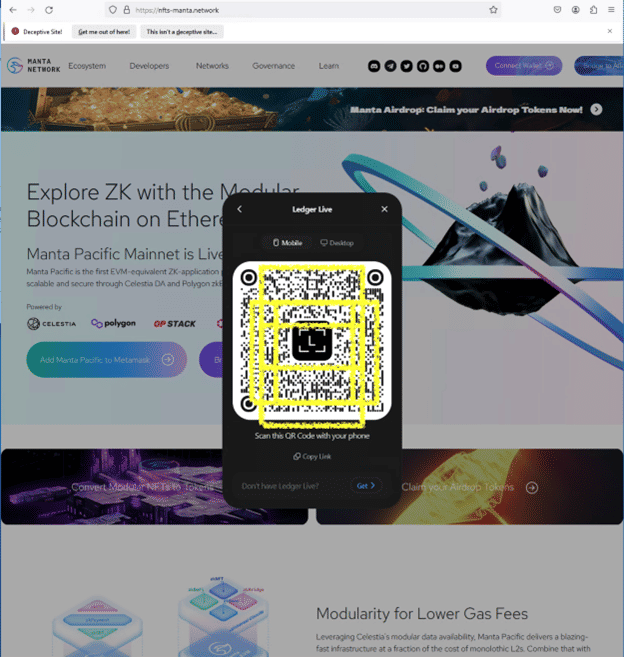
Security and fraud risks
AI branding can make investment claims sound more sophisticated than they are. The U.S. Securities and Exchange Commission’s investor alert on AI-related crypto scams warns that fraudsters may claim to use AI bots to find profitable crypto investments and may use AI-generated websites or deepfakes to build trust.
The alert does not prove that every AI-assisted blockchain product is fraudulent. It does show why investors should verify the people, custody arrangements, fees, audit claims, and performance evidence behind a service. Marketing language is not a substitute for independently reproducible data.
Crypto assets also carry risks unrelated to model quality. The SEC’s crypto asset securities investor guidance highlights volatility, illiquidity, platform failure, and fraud. An accurate model cannot protect an investor from a compromised contract, unavailable withdrawal, bad custody arrangement, or sudden loss of market liquidity.
What AI can and cannot do
AI is well suited to repetitive observation:
- Monitoring many wallets and contracts
- Summarizing changes across several chains
- Generating first-draft queries
- Comparing metrics over consistent periods
- Flagging unusual transactions
- Organizing evidence for further review
AI is less suited to decisions that depend on uncertain identity, changing incentives, legal interpretation, governance quality, or non-public context. It should not be treated as proof of future returns, a replacement for due diligence, or a guarantee against loss.
The strongest output is usually a research memo containing source links, query logic, charts, assumptions, competing explanations, and a clear statement of uncertainty.

Conclusion
AI turns blockchain data into investment insights by adding structure and scale to a difficult research problem. It can normalize transactions, classify wallet behavior, detect anomalies, compare protocol economics, and monitor liquidity or security-related events.
Its value depends on disciplined interpretation. Raw activity must be checked, wallet labels must be treated cautiously, and model outputs must be separated from verified observations. The practical goal is not to ask AI which asset will rise. It is to use AI to ask better questions, expose evidence faster, and identify the risks that deserve human review.
For investors, the most defensible process combines transparent on-chain data, reproducible queries, independent context, and conservative risk management. That approach turns AI from a prediction gimmick into a useful component of investment research.
You may also like
- AI Trading Bots vs Manual Trading: Which Works Better in 2026?
- Machine Learning-Powered SaaS for User Feedback Analysis: The Future of Product Insights
- Web Hosting Trends for 2026: AI, Edge Computing, and the Future of Your Website
- How AI Analyzes DAO Governance Risks
- Stablecoin Reserve Analysis: What Investors Need to Know